Odoone Etebara · for money-transfer and exchange desks
The money-transfer desk that keeps the books for you.
اعتبار شما، امانتِ ما
Recording a transfer takes four inputs and four taps: who it is with, what you receive, at what rate, and who gets paid. The customer leaves with a printed receipt and can be handed a statement of their whole history in their own language. Underneath every tap, real double-entry accounting is written for you — the person at the counter never sees a debit or a credit, and the book-keeper never re-types anything.
On Odoone Cloud from AED 348 a month, excl. VAT, with 6 users. Live in five days.
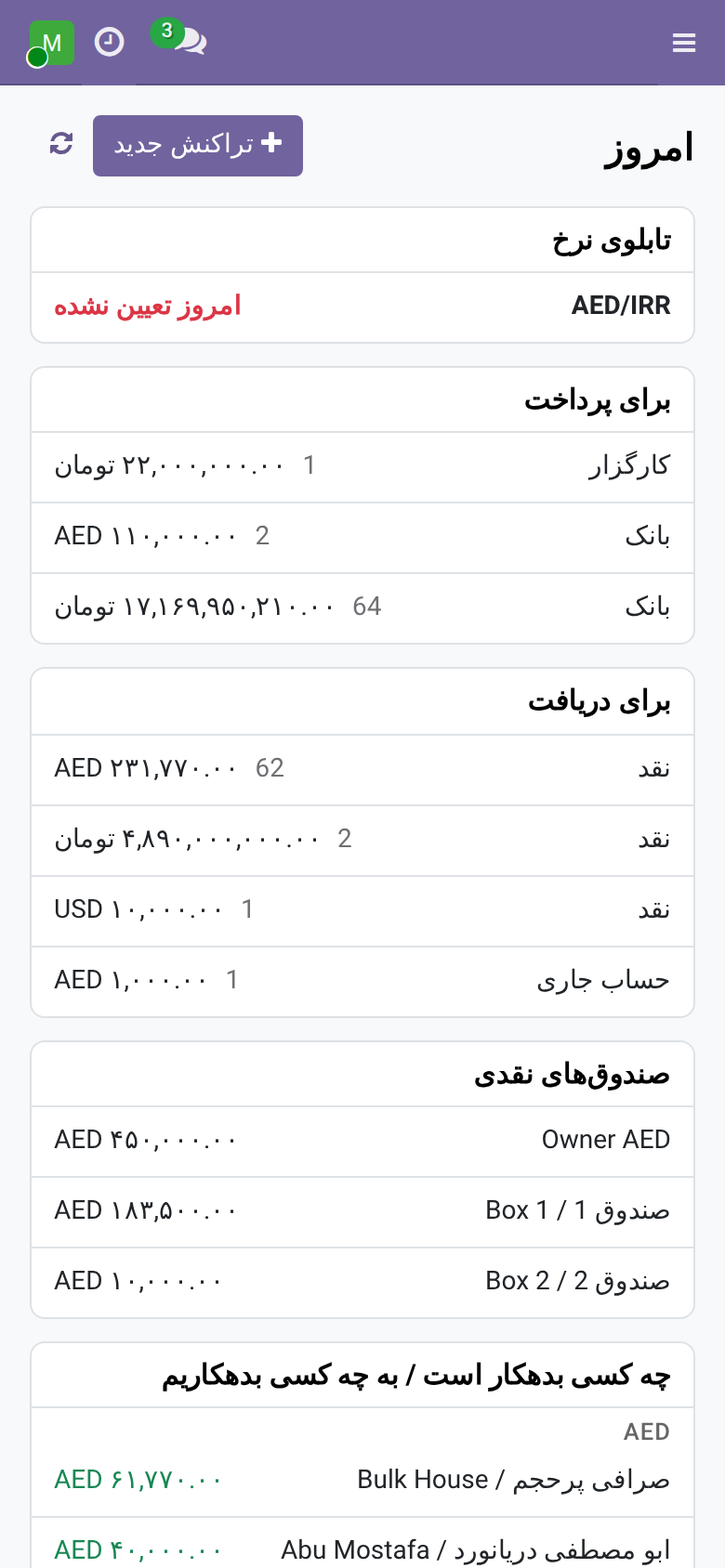
Desks, not accounting firms.
Etebara is built for people who run a hawala or exchange counter and are not accountants. The screens are for the operator; the ledger is for the auditor.
Any corridor, any currency.
Iran, the UAE, Turkey, Oman, Iraq, Afghanistan, China — and any other pair you trade. Rates are typed the way you say them; Toman is shown as Toman while Rial is what is stored.
From the counter, on a phone.
The layout is designed at phone width, right-to-left, because that is where a desk actually works. It is the same app on a laptop.
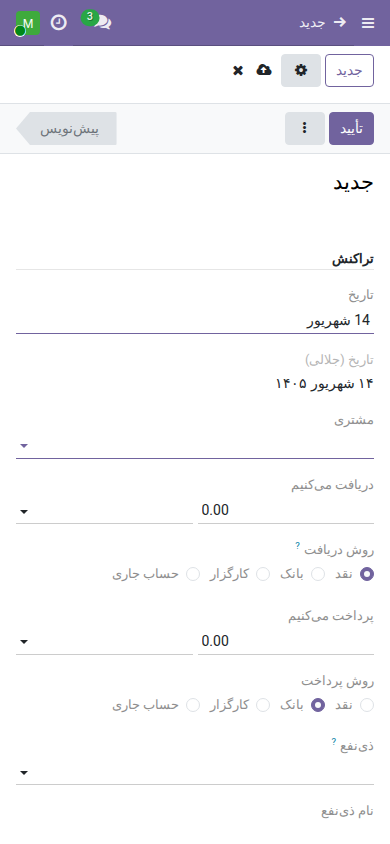
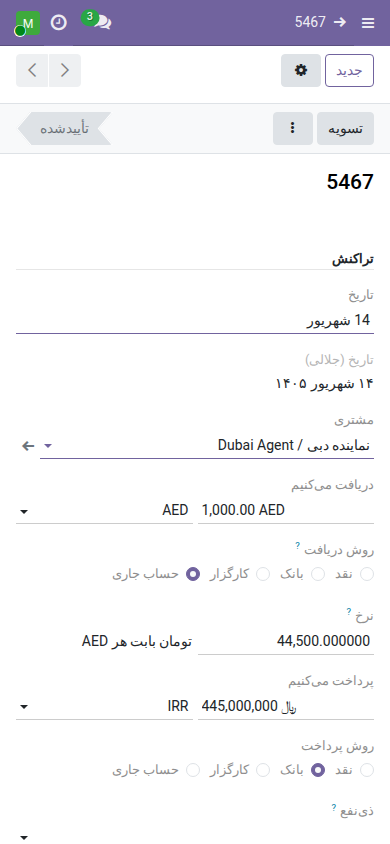
Four inputs. Four taps. One posted transaction.
- Customer — who the transaction is with. Type two letters; create inline if new.
- We receive — the amount and the currency.
- Rate — in the units you say out loud. "Forty-four thousand five hundred Toman per dirham" is typed as it is said; Etebara converts to what the engine stores, and the units stay on the screen.
- Beneficiary — who is actually paid, which is often not the customer.
We pay fills itself in from the rate. The two method rows — cash, bank, agent, current account — default sensibly and change with one tap.
The four taps: pick the receive method, pick the pay method, Confirm, then Share the receipt or hand it over.
What Confirm does behind the scenes: it creates the two settlement legs, writes two rows to the customer's side of the ledger (you owe us / we owe you), posts the accounting entry, and checks the customer's credit ceiling. If the ceiling would be exceeded, the confirm is refused and tells you by how much.
Everything waiting for you, in the order it is waiting.
Rate board. Today's rate for each pair you trade. A stale rate never stops you reading anything — it only stops you confirming. Freshness is a rule about posting, never about reading.
To pay and To receive. What you owe and what is owed to you, grouped by how it will move — cash, bank, agent, current account — with a count and a total per line, and the action on the row.
Cash boxes. Every box and its balance, per currency.
Who owes, whom we owe. The position of every customer and agent, per currency, straight from the ledger. Nothing on this screen is cached behind your back.
Settled leg by leg, because the two legs settle differently.
The cash leg — a handover.
The cashier picks the transaction, picks or creates the courier (name, ID-card type and number, optionally a photo of the card), enters the amount and confirms. The cash box moves, the receipt prints, the leg closes by that amount. A draft handover changes nothing; nothing moves until it is confirmed — which is what makes the signed handover receipt worth having.
The bank leg — a receipt, then apply it.
Record the receipt with its proof image, verify it, then apply it to the amounts it covers. One receipt can cover several transactions and one transaction can be covered by several receipts — that is the normal case. An unverified receipt cannot be applied: verification is the moment the money is real.
Settlements and netting.
A settlement closes a customer's or an agent's position for a date. Lines settle in cash, by bank, or by netting — offsetting what you owe against what you are owed at a stated rate. The netting rate is recorded on the line and posted as its own accounting entry, so the currency effect of netting is never buried inside the settlement.
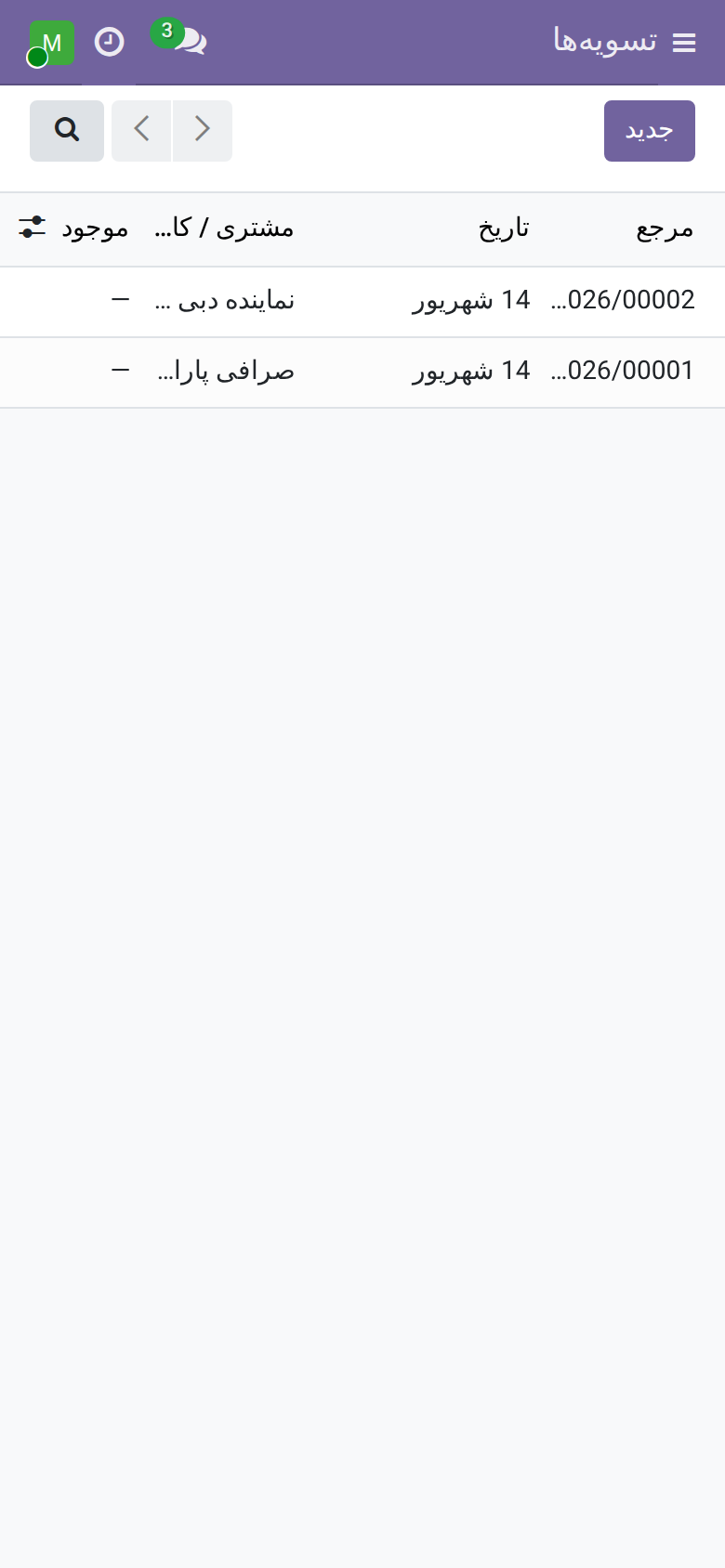
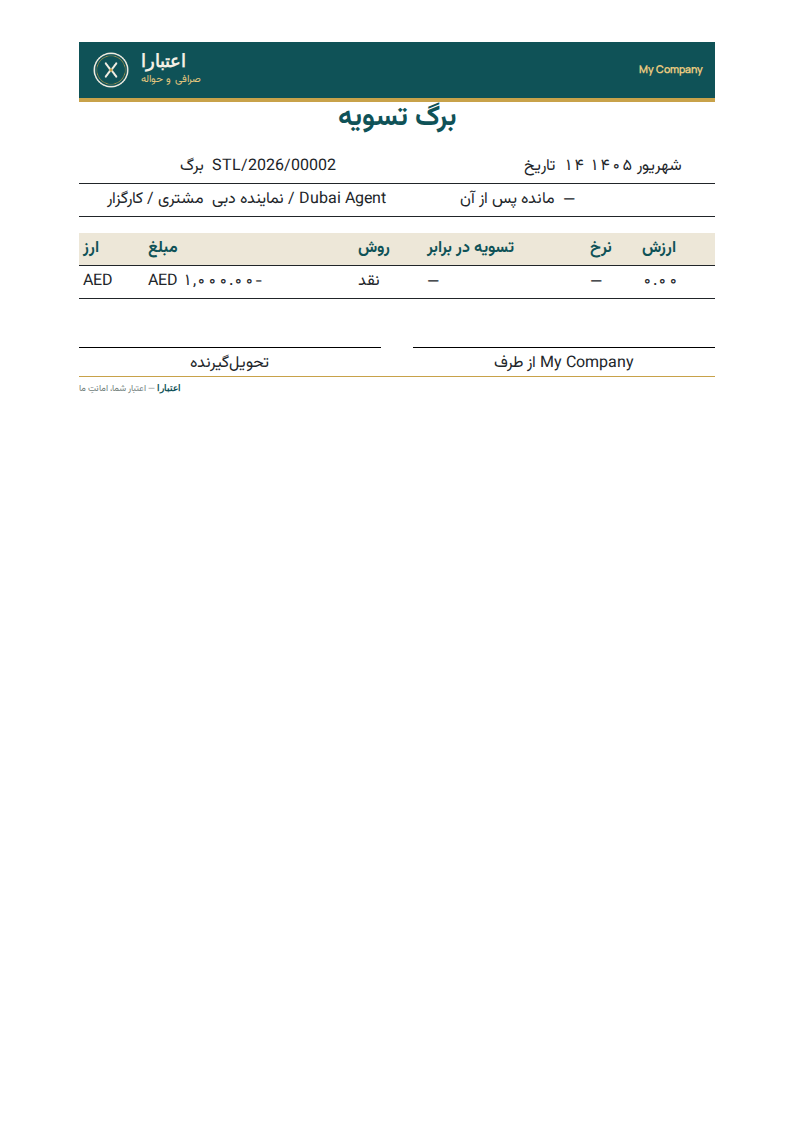
A receipt they can trust, a statement they can read.
One receipt, two copies. The customer copy shows the transaction; the operator copy adds cost and profit. They are the same document with the cost block switched off, so the customer copy can never leak a cost figure.
The statement, in the customer's language. Per-currency balances and the full history, in Jalali and Gregorian dates. Set the language on the customer's record and the statement follows. It never prints a bare negative number: it says "owes us" or "we owe" in words, because a minus sign on paper is the most common way a statement gets misread.
Share from the form. Every receipt and statement can be shared straight to WhatsApp.
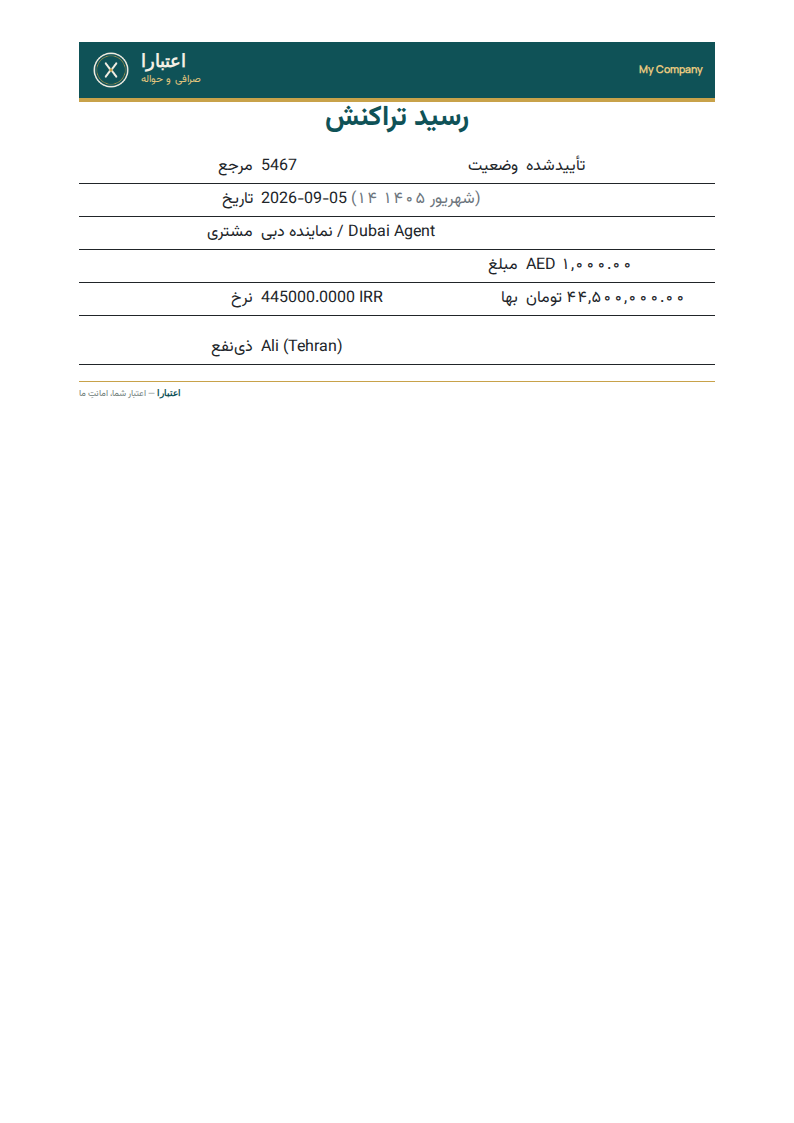
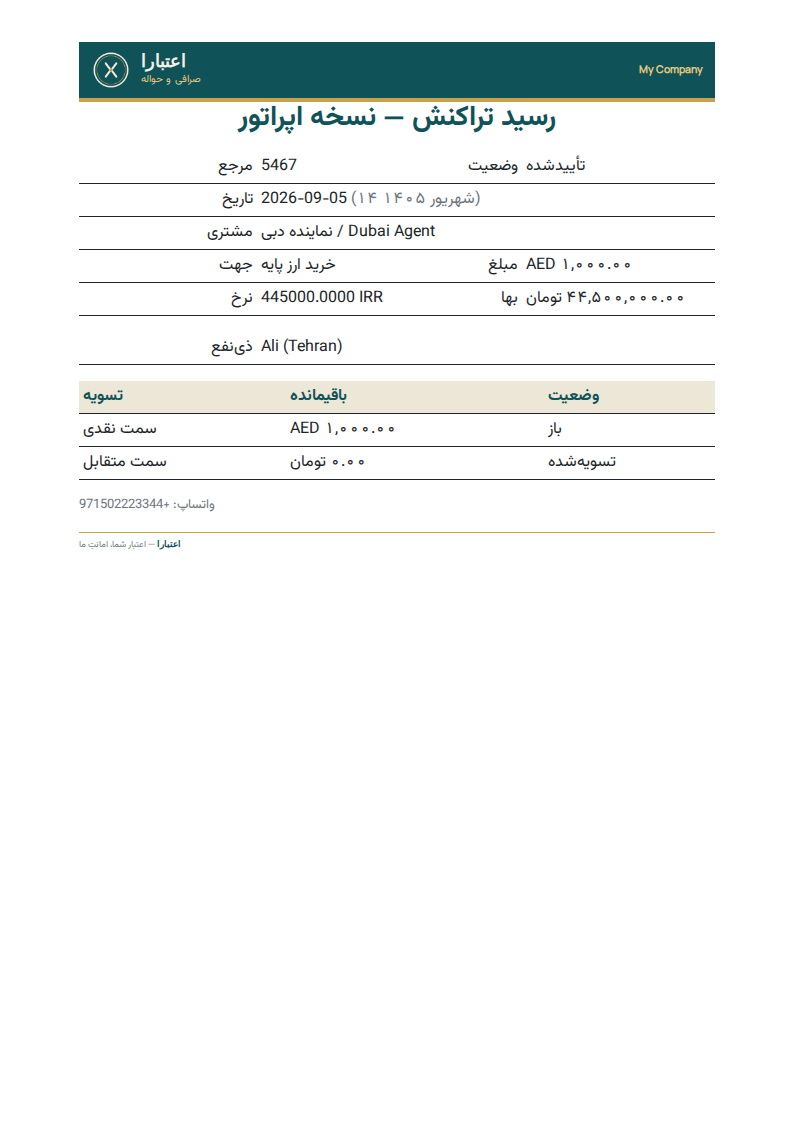
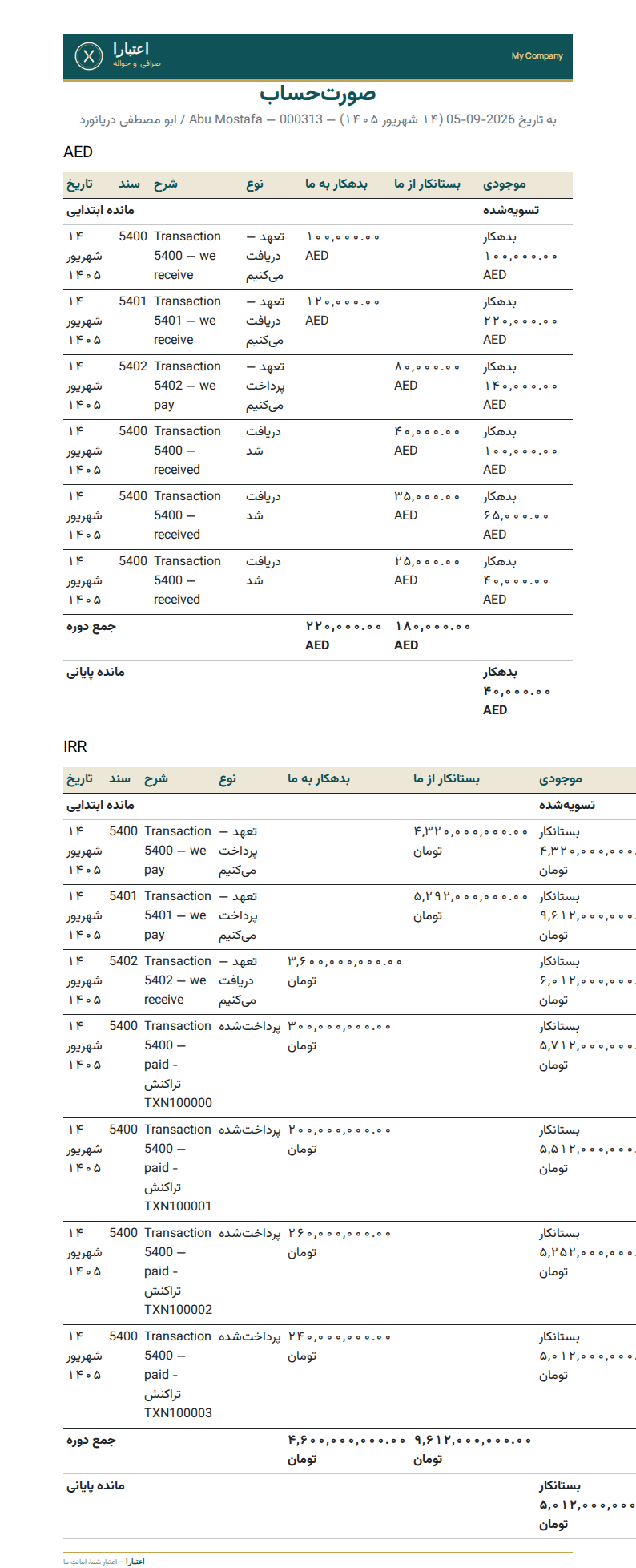
Reports you can check by hand.
| Report | Answers |
|---|---|
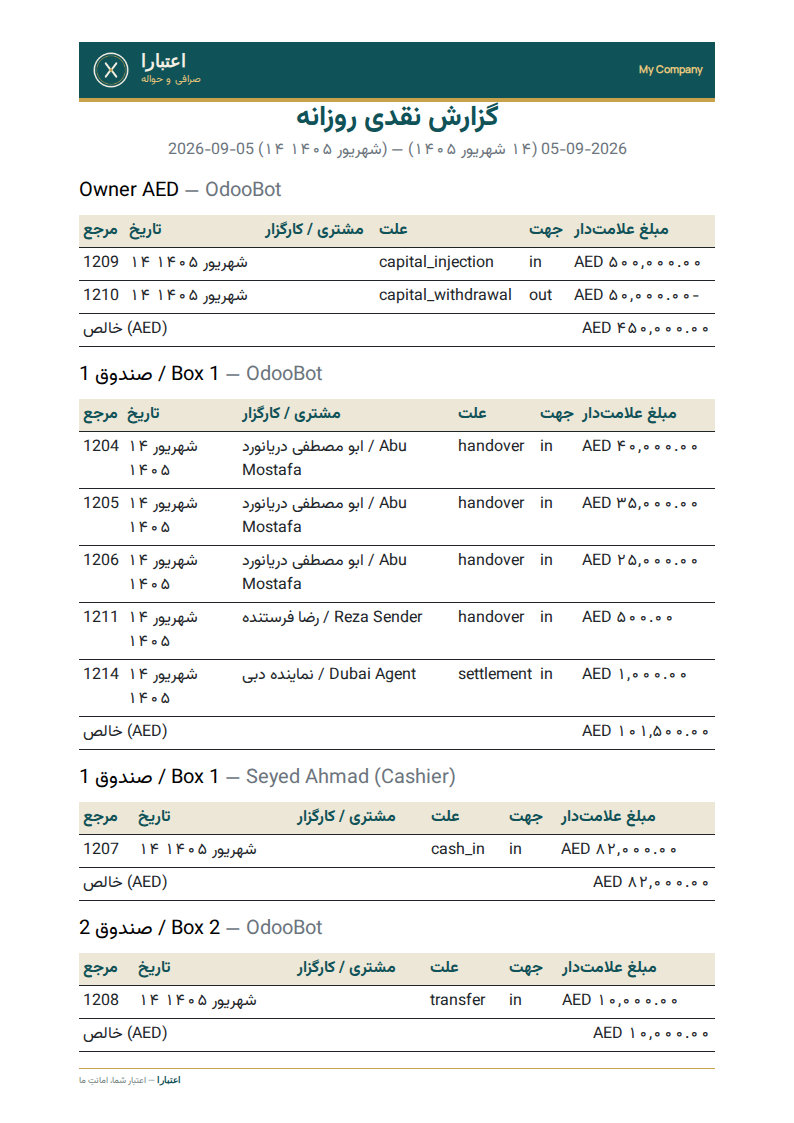
| Daily cash | What moved through each box today, and who moved it |
| Profit | Realized and unrealized, by period, transaction or currency — on oldest-first cost |
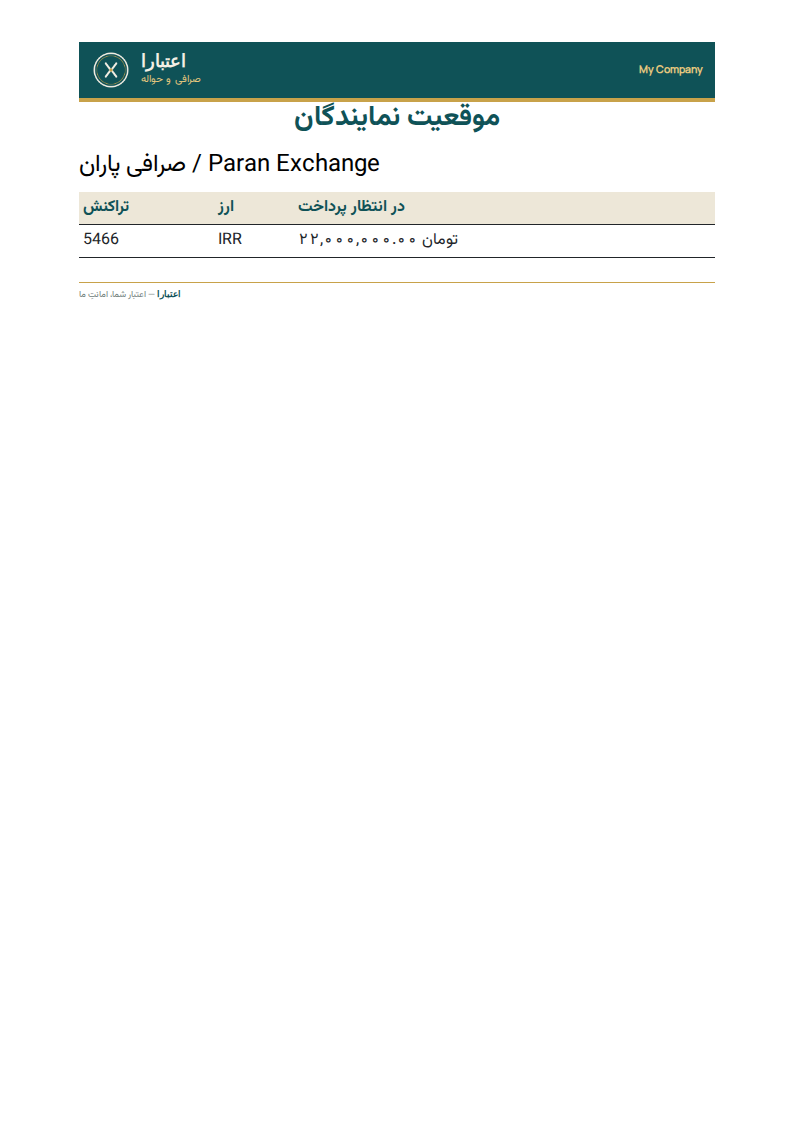
| Agent positions | What each agent owes you or you owe them, per currency |
| Statement | One customer's or agent's full history and balance |
| Open positions | Currency bought and not yet sold |
The profit figure is oldest-first — the first currency you bought is the first you sell — and every number can be reproduced from the lot rows behind it. If a figure ever looks wrong, open the transaction and read the lots it consumed: the arithmetic is there, not hidden in an average.

Accounting you never have to touch
- Installing Etebara creates the journal and the ledger accounts the desk posts to, for every company on the database. You do not build a chart of accounts first.
- Every confirm, handover, receipt and settlement posts a double-entry accounting entry. Nobody at the counter sees it; the book-keeper never re-types it.
- Nothing in the ledger is ever edited. A correction is a reversal — a new row with the sides swapped — so the history of a mistake survives the fix, and a balance you printed last month still prints the same today.
- A cancelled transaction does not vanish: its lots, outstanding amounts, balances and accounting entry are reversed, dated the day it happened. Only the correction of an erroneous posting is back-dated to the original date.
- The rate you type is the rate that priced the trade. Etebara never silently re-prices a confirmed transaction, including on a back-dated confirm.
- The customer sub-ledger and the general ledger agree, and the product checks that they do.
Three roles
| Role | Can do | Cannot do |
|---|---|---|
| Manager | Everything: set rates, price transactions, see profit, accounting, capital | — |
| Accountant | Create transactions, record and verify receipts, apply them, settle, print statements | Set the rate |
| Cashier | Cash in and out of a box, receive and deliver cash, capture the courier's ID, print the handover receipt | See rates or profit |
The manager is a superset of both. Accountant and cashier are parallel specialists — a handover stays a cashier's job, and an accountant cannot create one.
Customers informed at every step — without anyone typing a message.
- When an operator confirms a transaction, confirms a cash handover, or applies a bank receipt, the customer receives a Telegram message — rendered in their language (Persian, Arabic or English) — for every stage: confirmed, settled, completed, cancelled; cash received and delivered; receipt applied.
- Messages are role-scoped: an agent or a beneficiary on the transaction is never named in the customer's message.
- Customers opt in with a one-tap invite link from their record. Delivery, retries and failures are visible in one place, and every sent message is logged on the transaction.
- Optional two-way replies: the customer can tap Status or Report an issue. These are signals only — they open a note and a to-do for your team. A tap on Telegram can never move money; every state change stays with the operator.
- Included with the Etebara Remit add-on on Odoone Cloud.
Compliance, as an add-on — when your desk is required to run it.
- A due-diligence file for every counterparty — the sender included — with risk scoring, screening and the documents that go with it; a queue that ranks the files still to complete by exposure, so the largest are regularised first.
- A gate that blocks a transaction whose counterparty has no completed file. It ships off. Once switched on it cannot be switched off — the moment a transaction is first blocked is exactly the moment nobody should be able to disable the block. The intended path is to complete the file, and that leaves a record.
- A retention clock computed from the most recent of six statutory events, with five years as a floor you can raise and never lower.
- Suspicious-transaction cases, decided by the MLRO, and a configurable goAML export.
- Written for Federal Decree-Law 10 of 2025, Cabinet Resolution 134 of 2025 and CBUAE Circular 24/2019, with the statutory citations kept as configuration so they can follow the law. The Arabic text of those instruments is the law; every English rendering is unofficial.
- Optional, and never sold on its own: it screens transfers, so it needs a desk.
Persian, Arabic and English — switched on the day you install.
Installing Etebara turns Persian and Arabic on for the whole database, because receipts and statements are printed in them. Screens run right-to-left where the language does; dates show in Jalali and Gregorian; the customer's documents follow the customer's language, not yours.
Prices, from the same sheet as every invoice.
| Etebara — Remit (Start) | AED 199 per company per month on the Start tier, excl. VAT. Includes the Telegram bridge and 3 extra users: 6 in all, for AED 348 a month all-in, excl. VAT. |
| Etebara — Remit | AED 299 per company per month on Business and Growth, excl. VAT, where the tier's own users and support hours apply. |
| Etebara — AML add-on | AED 149 a month on Business and Growth, excl. VAT. Requires a Remit desk. |
| Etebara Launch | AED 5,000 once, excl. VAT: two 90-minute trainings, 30 days of hypercare, and the migration of up to 200 partners and their balances. Etebara can also be added to Launch Plus or Launch Pro for AED 3,000, excl. VAT. |
| Etebara Launch — switch offer | AED 3,500 instead of Launch, excl. VAT, for the first 10 desks moving from another system, until 2026-12-31. Requires permission to be named as a reference and an export of customers and balances from the previous system. |
| Etebara — three years prepaid | The tier base fee and the Remit add-on for 36 months, invoiced once at 25 months' list. Annual plans are invoiced at 10 months. |
Odoo + Odoone apps, hosted and maintained by Odoone.
Your instance is hosted in the EU by default; hosting in the UAE is available as an add-on.
All prices exclude 5% VAT.
Live in five days.
- Day 1 — your desk exists. Your Odoone Cloud database, Etebara installed, your users and roles, your currencies and today's rate.
- Day 2 — first training (90 minutes). The Worklist, the four inputs, receipts and statements, on your own data.
- Day 3 — your customers and balances. We migrate up to 200 partners and their opening balances from the export you give us.
- Day 4 — second training, dry run. Settling, handovers, bank receipts, reports; a day's transactions rehearsed end to end.
- Day 5 — live. Thirty days of hypercare follow: a person who answers.
Questions desks ask
Do I need to set up a chart of accounts first?
No. Installing Etebara creates the journal and the accounts it posts to, for every company on the database.
Is Toman supported, or only Rial?
Both, deliberately: Rial is what is stored and Toman is what is shown by default; you can switch the display in Settings. The stored numbers never change.
Can I edit a ledger row?
No — and that is the point. A correction is a reversal, so the history survives and last month's printed balance still prints the same today.
What happens to a cancelled transaction?
Its lots, outstanding amounts, balances and accounting entry are all reversed, dated the day of the cancellation.
Why was my confirm refused?
The message says which rule refused it: a stale rate, a credit ceiling, a missing rate, or a leg that is already settled.
Can a customer move money from Telegram?
No. A tap on Telegram can only ask for a status or flag an issue. Every state change stays with the operator.
Do I have to install the AML add-on?
Only if your desk is required to run compliance checks. The desk works without it.
Which languages do my customers' documents come in?
The language set on the customer's record — Persian, Arabic or English — regardless of the operator's own language.
See a transfer recorded in four taps — on your own numbers.
Request a demo See the full price list
Etebara runs on Odoo 19 Community, made by Odoone · [email protected]
This content is general information for UAE businesses, not tax, legal, or financial advice. Rules change and cases differ — speak to a qualified advisor about your situation.